


Your Parent Roadmap
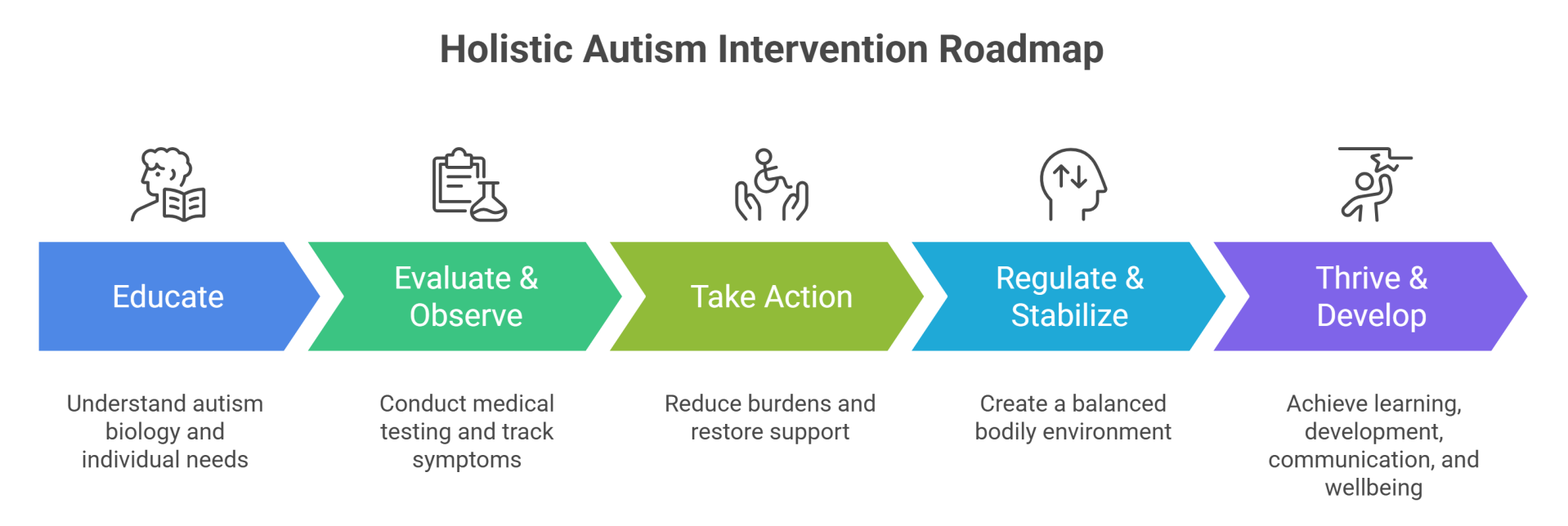
Holistic Autism Intervention — Step by Step
Understanding where to start, what to focus on, and how to move forward — one step at a time.
This roadmap is here to help you begin without overwhelm.
Make yourself comfortable, take a quiet moment, and start by getting an overview of the bigger picture: what may be happening beneath the surface of autism, how the body as a whole may be involved, and which first steps can help you support your child safely and realistically.
You do not need to do everything at once.
Start with understanding.
Then observe and evaluate.
Then take action — step by step, based on your child’s individual needs.
Your Journey Ahead
Your child’s body must feel safe, stable & nourished to learn.
Beginner-Friendly Route
Start with the All-in-One Parent-Friendly Autism Handbook
This all-in-one handbook gives parents a practical overview of:
- autism biology,
- common underlying stressors,
- medical testing,
- nutrition foundations,
- supplementation,
- and step-by-step support strategies.
It is designed as a simple starting point to help parents understand:
- where to begin,
- how the different pieces connect,
- and how to move forward step by step.
👉 Download the Parent-Friendly Autism Handbook here

| Step | Focus | What You’ll Learn / Do | Where to Start |
|---|---|---|---|
| 1 | Start with the Basics | Understand autism biology, common underlying stressors, gut health, inflammation, nervous system stress, immune dysregulation & nutritional foundations | Parent-Friendly Autism Handbook |
| 2 | Understand Your Child’s Patterns | Track digestion, sleep, regulation, mood, learning, sensory challenges & daily functioning | Pages 29–36 |
| 3 | Plan Foundational Medical Testing | Discuss blood work, stool analysis, nutrient levels & food sensitivities with your healthcare provider | Pages 29–36 |
| 4 | Begin Foundational Support | Start with nutritional foundations and basic support strategies commonly used in autism | Pages 37–48 |
| 5 | Adjust Nutrition & Lifestyle | Implement the Autism-Friendly Diet, reduce stress, support regulation & daily nervous system stability | Pages 69–72 |
| 6 | Add Specialized Support if Needed | Explore individualized support options based on your child’s unique needs and test results | Pages 49–66 |
| 7 | Focus on Gut Health & Inflammation | Learn more about digestion, microbiome balance, stool patterns & gut-related symptoms | Volume 6 – Gut Health & Poop Book |
| 8 | Support Development Through Daily Life | Create nervous-system-friendly routines, play, movement & developmental support strategies | Volume 7 – Coming before 31.05.2026 |
| 9 | Review Progress | Reassess symptoms, repeat helpful testing & adjust the support plan step by step | Pages 29–36 |

In-Depth Route
Explore the Full Autism Uncovered Guide Series
1. Educate
Understand your child’s biology and where to start.
Recommended Guides:
Decode Autism & Its Biological Drivers
Before taking action, parents first need to understand what may be happening beneath the surface of autism.
This includes learning about:
- gut health
- immune dysregulation
- nervous system stress
- inflammation
- nutritional deficiencies
- sensory overload
- environmental stressors
Knowledge creates clarity, direction, and stronger parent advocacy.

2. Evaluate & Observe
Recognize patterns, track changes, and decide what matters.
Recommended Guides:
a) Build Your Child’s Individual Health Profile
Many autistic children have underlying health challenges that go unnoticed, yet may strongly influence their individual autism biology, regulation, and symptoms.
Foundational testing may include:
- comprehensive stool analysis,
- blood work for nutritional status & inflammation markers,
- food sensitivities & allergy testing, including histamine intolerance.
This helps identify common autism-related health burdens and better understand:
- what may be missing in the body,
- and what may be there that does not belong there.
This creates a clear starting point for tailored intervention strategies, including:
- addressing infections,
- supporting gut health,
- nutrition & dietary intervention,
- targeted supplementation,
- and lifestyle support.
b) Track Patterns & Progress
Track digestion, sleep, mood, regulation, behavior, learning, sensory challenges, and daily functioning over time.
Retesting and reevaluation after approximately 4–6 months can help measure improvements and identify remaining challenges.

3. Take Action
Apply safe, practical strategies adapted to your child’s needs.
Recommended Guides:
📘 Vol 4 – The Ultimate Autism Supplement Guide
📘 Vol 5 – The Autism-Friendly Diet Guide
📘 Vol 6 – Gut Health & Poop Book Guide
📘 Vol 7 – Everyday Skills & Regulation Guide (in the making)
Reduce Burdens & Restore What the Body May Be Missing
a. Treat Detected Infections
Work together with your child’s healthcare professional when infections or medical concerns are identified.
b. Introduce a Foundational Supplement Plan
Start with basic nutritional support and add targeted supplements gradually where needed. More
c. Implement an Autism-Friendly Diet
Focus on nourishment, gut support, blood sugar stability, digestion, and reducing unnecessary stressors. More
d. Create a Supportive Home & Lifestyle Environment
Reduce overwhelm while supporting regulation, independence, sensory needs, life skills, movement and play-based learning. A stable and nourished body is receptive to progress.
e. Reduce Stress & Nervous System Overload
Support emotional regulation, nervous system stability, sleep, routine, and recovery.
f. Detoxification (Only When the Body Is More Stable)
Detoxification should be approached carefully and only after the body is more nourished, regulated, and supported.
Review Progress over Time
Repeat important testing where helpful, compare symptom changes, and adjust support strategies step by step.
Holistic autism support is not about perfection —
but about continuously building:
- regulation,
- resilience,
- learning capacity,
- independence,
- and quality of life over time.

Moving Forward — One Step at a Time
You do not need to understand everything at once.
The goal is not perfection. The goal is to:
- reduce overwhelm,
- better understand your child,
- support the nervous system,
- stabilize the body,
- and create an environment where development becomes more possible.
Many families begin by:
- improving nutrition,
- reducing stress,
- supporting sleep and regulation,
- identifying medical burdens,
- and introducing developmental support step by step.
Over time, small consistent changes can create meaningful progress.
